Travel in North Korea: when to go, places and advice
The most closed country in the world can only be visited on an organised tour, escorted at all times by two guides: that is precisely what makes it an experience apart. Pyongyang and its outsized monuments, the deepest palace-metro in the world, the DMZ seen from the north, the Myohyang mountains and the omnipresent cult of the leaders compose a journey outside every norm. Be sure to check the entry conditions and official advice before making any plans.
- Capital
- Pyongyang
- Currency
- North Korean won; euros and yuan accepted
- Language
- Korean
- Direct flight
- No direct flight, via Beijing
- Time difference
- +8 hr in winter, +7 hr in summer
Itineraries
Our trip ideas in North Korea
The itineraries in North Korea are in the works: the day-by-day programme, named hotels, tickets to book flagged in advance. Leave your address to be notified when they come out.
Got it. You will be notified at the next release.
The sign-up could not be completed. Try again in a moment.
Your address is only used for these release announcements. Privacy policy
The right season
When to go in North Korea?
The tours run mainly from April to October. Spring and autumn offer the best climate, clear skies and 15 to 25 °C, with the great April celebrations and the reddened landscapes of October. Summer is hot and rainy, the season of the Korean monsoon. Winter, Siberian, drops below -10 °C and severely limits the programmes.
- January : In-between
- February : In-between
- March : Pleasant
- April : Ideal
- May : Ideal
- June : Pleasant
- July : In-between
- August : In-between
- September : Ideal
- October : Ideal
- November : Pleasant
- December : In-between
- Ideal
- Pleasant
- In-between
- Avoid
Quick guide
Understanding North Korea
Getting around
No free movement: group bus, chartered train or domestic flight, always with the guides. Entry is through Beijing, by plane or by the mythical 24-hour Beijing-Pyongyang train.
Money
Tourists never handle the won: everything is paid in euros, yuan or dollars in small notes, in the designated shops. No bank card works, bring all the cash for the stay.
Language
Korean, in a variant that has stayed very pure. The guides speak English, sometimes French. No spontaneous contact with the population is on the programme.
Useful apps
Your phone now comes in with you, but with no internet and no signal: load maps, dictionaries and offline reading before Beijing. Photos are checked on the way out, follow the guides' instructions.
Accommodation
The hotels reserved for foreigners, like the Yanggakdo on its island in the Taedong river: dated comfort, a unique atmosphere, and you do not leave the hotel without your guides.
Etiquette
Bow before the statues of the leaders, never fold or throw away a newspaper bearing their image, photograph the monuments in full: the rules are non-negotiable and your guides answer for you.
The iconic places
Juche Tower
Pyongyang
170 m dedicated to the national ideology, facing Kim Il-sung square. The lift climbs to the flame for a total panorama over the capital.
Kim Il-sung Square
Pyongyang
The esplanade of the great parades, lined with ministries bearing monumental frescoes. The symbolic heart of the country.
Monument to Party Founding
Pyongyang
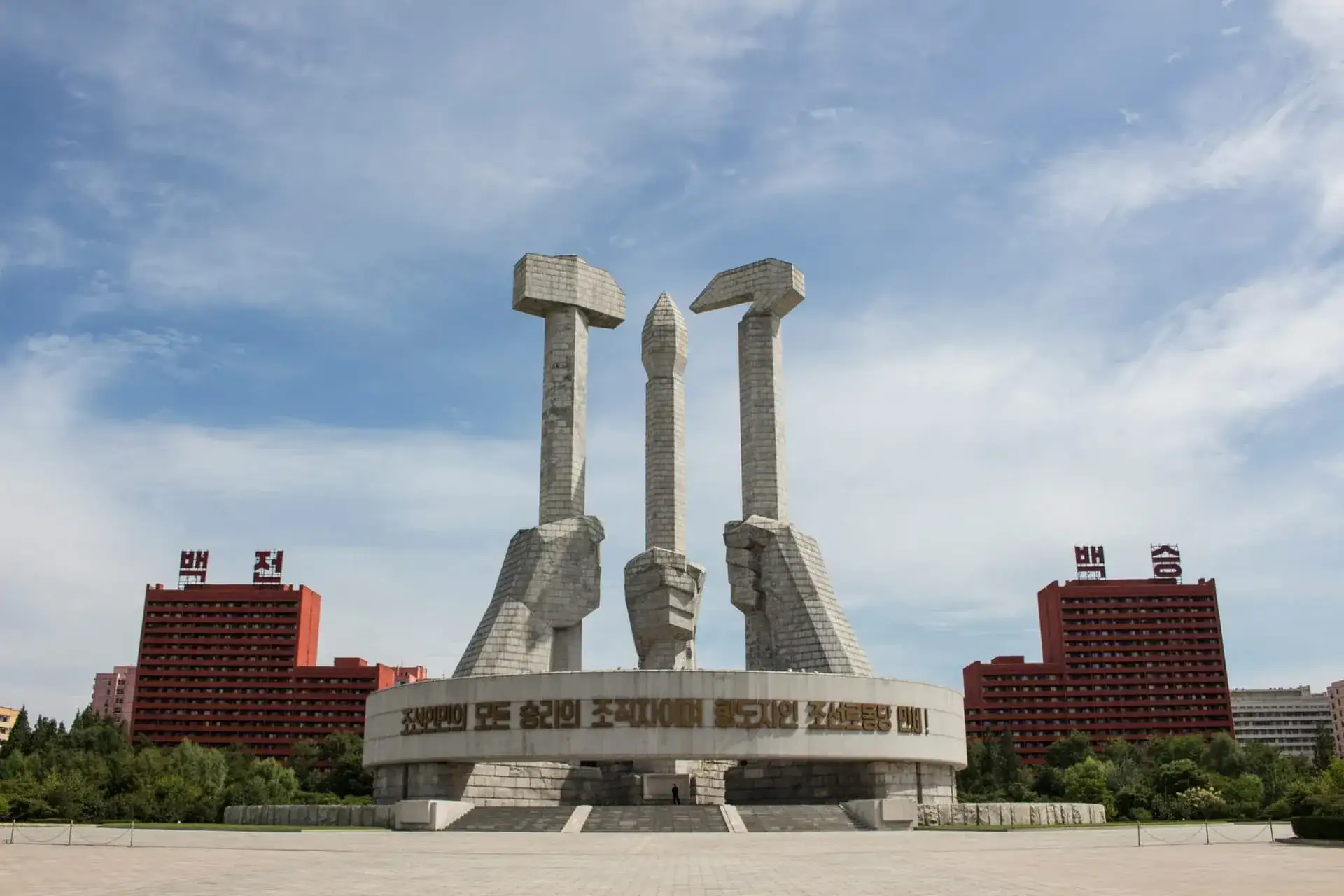
A 50 m granite hammer, sickle and writing brush: the worker, the peasant and the intellectual united in the country's most photographed emblem.
Panmunjom
DMZ
The blue armistice huts seen from the northern side: the mirror experience of the South Korean visit, gripping in its calm tension.
Kaesong
Kaesong
The former capital of the Koryo kingdom, its preserved traditional houses and the royal tombs around it, UNESCO-listed.
Mount Paektu
Chinese border
The nation's sacred volcano and its crater lake Chonji. The official birthplace of the revolution, reachable on some summer tours.
Tap a dot, or browse the list below the map.
- Juche Tower : 170 m facing the Taedong river
- Kim Il-sung Square : The parade esplanade
- Monument to Party Founding : Granite hammer, sickle and brush
- Arch of Triumph : Taller than the one in Paris, 60 m
- Panmunjom : The DMZ from the northern side
- Kaesong : The former Koryo capital, UNESCO
- Myohyang Mountains : Temples and the Friendship Exhibition
- Wonsan : Seaside resort of the east coast
- Mount Paektu : The sacred volcano and its lake Chonji