Skip to content
Étaperia

Bolivia in 13 days: La Paz, the Yungas and the Cordillera Real, day by day

Thirteen days to get used to the altitude: La Paz by Mi Teleférico, the Valle de la Luna, Plaza Murillo and the Mercado de las Brujas, the Valle de las Ánimas, Tiwanaku and Puma Punku, the Death Road by mountain bike, three days on the Camino del Choro, Coroico, the Zongo pass facing Huayna Potosí, and Sorata.

Compiled by Kylian, updated on Oct 25, 2026

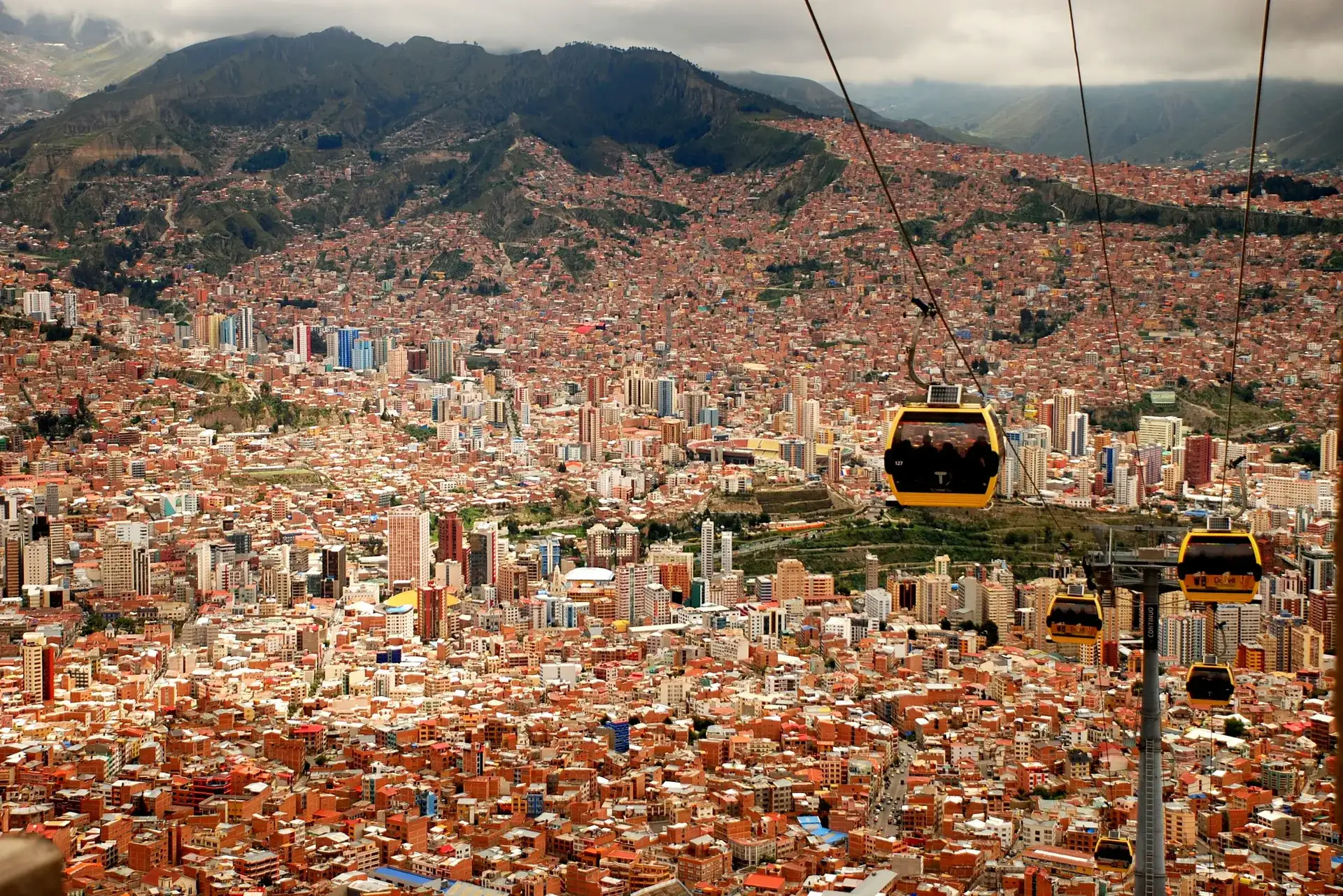
La Paz seen from a yellow Mi Teleférico cable car, red-brick houses covering the slopes of the basin
  • 13 days
  • 37 places
  • 13 nights
  • fast pace
Start
La Paz, El Alto airport
End
Sorata
Main transport
Private transfers and guided excursions by vehicle from La Paz, Mi Teleférico and taxis in town, three days' trekking on the Camino del Choro and a descent of about 3,500 m (11,480 ft) by mountain bike on the Death Road on day 7
Recommended season
Dry season, May to October: clear skies on the Altiplano and the treks, with nights below freezing above 4,000 m (13,120 ft) in June and July; from December to March the rains turn the Choro muddy and can cut the Yungas roads

What you get

  • The complete itinerary: 13 days sequenced Morning / Afternoon / Evening / Hotel
  • The card of every hotel, with the address and a direct booking link
  • Quota tickets, fixed-date tickets and surcharges flagged in advance
  • The country quick guide: weather, transport, formalities, budget
  • A PDF file of 21 pages

What the price does not include

  • Flights
  • Hotel nights
  • Tickets and admission fees
  • Travel insurance
  • On-the-ground assistance during your trip

The itinerary preview

The free day in full, with its hotel card. This is the sample.

Day 3

Historic and colonial La Paz

Morning

Plaza Murillo 3,650 m

The political heart of the country, the square is named after Pedro Domingo Murillo, a hero of independence executed here in 1810. It is bordered by the cathedral, the Palacio Legislativo and the Palacio Quemado. Pigeons, shoeshiners and the changing of the guard make up the daily scene.

Palacio Quemado

The former presidential palace owes its nickname, the “burnt palace”, to the fire of 1875, during an uprising. Its neoclassical façade overlooks Plaza Murillo. Since 2018, the presidency has been housed in the neighboring tower of the Casa Grande del Pueblo; the palace is mostly seen from the outside.

Teatro Municipal Alberto Saavedra Pérez

Opened in 1845, it is one of the oldest theaters in South America still in use. Its restored Italian-style auditorium hosts concerts, dance and theater. It stands on the corner of Calles Genaro Sanjinés and Indaburo, a stone's throw from the square.

Afternoon

Mercado de las Brujas

In Calles Linares, Santa Cruz and Sagárnaga, the stalls sell medicinal herbs, amulets, figurines and dried llama fetuses used as offerings to Pachamama. It is one of the most singular places in La Paz, where Aymara ritual practices live on.

Basílica de San Francisco and its museum

Founded in 1548 and rebuilt in the 18th century, the basilica is a masterpiece of mestizo baroque, in which indigenous sculptors blended Andean and Christian motifs. The adjoining museum opens up the cloister, the cells, a collection of religious art and the rooftops, from where the view takes in the square and Illimani. Official website:

Museo de la Coca

A small museum on Calle Linares devoted to the coca leaf: its age-old use in the Andes, its place in rituals and daily life, then its transformation into cocaine and the political issues that follow from it. Official website:

Mercado Rodríguez

A working-class market in the San Pedro district, especially lively at weekends, when the streets fill with stalls of fruit, vegetables, cheeses, meat and bread. An immersion in the daily life of the Paceños, far from the tourist circuits.

Good to know

A day on foot in streets that climb steeply: plan for breaks. The San Francisco museum takes about 1 hr to visit, rooftop access included. Keep an eye on your belongings in the markets and ask before photographing the women stallholders.
Hotel · Night 3

Madero Hotel & Suites

A recent hotel in the center, fitted out in wood paneling, one minute from Plaza del Estudiante and within walking distance of Plaza Murillo. Panoramic restaurant on the 7th floor, buffet breakfast included, private parking. A base for the days in the center and the day trips.

Address
· Calle México 1822, La Paz
Check-in
2:00 PM · Check-out 12:00 PM
Book this hotel (new tab) affiliate link

Buy this itinerary

€39 incl. tax

that is €3.00 per day of travel

Billed in euros. If your card is in another currency, your bank converts at its own rate.

  • Secure payment through Stripe, bank card, Apple Pay and Google Pay
  • Available immediately in your customer account: online reading with clickable booking links, downloadable PDF for offline use
  • Method: what is checked, and when

A hotel in the itinerary closed or impossible to find, a place to visit permanently closed?

Within 12 months of purchase, email contact@etaperia.com

Itinerary corrected within 7 days, or refunded in full. Terms in article 12 of the terms of sale, on top of the legal warranty (new tab)

€39 incl. tax · 13 days

Buy

A question before buying? Email Kylian, reply within 2 business days.

The day-by-day rundown

13 stops, 350 km as the crow flies

  1. Day 1 Arrival in La Paz, a first flight by cable car El Alto international airport 4,061 m Day reserved for buyers, unlocked in the PDF
  2. Day 2 Zona Sur, from the natural history museum to the Valle de la Luna Museo Nacional de Historia Natural Day reserved for buyers, unlocked in the PDF
  3. Day 3 Historic and colonial La Paz Plaza Murillo 3,650 m Free
  4. Day 4 The revolution and the viewpoints, La Paz seen from above Plaza Villarroel 3,710 m Day reserved for buyers, unlocked in the PDF
  5. Day 5 Valle de las Ánimas and Palca canyon Valle de las Ánimas 3,965 m Day reserved for buyers, unlocked in the PDF
  6. Day 6 Tiwanaku, a full day Tiwanaku archaeological site 3,842 m Day reserved for buyers, unlocked in the PDF
  7. Day 7 The Death Road by mountain bike Camino de la Muerte with Gravity Bolivia 4,700 m → Yolosa Day reserved for buyers, unlocked in the PDF
  8. Day 8 Camino del Choro, from La Cumbre to Challapampa Camino del Choro, day 1 4,700 → 4,859 m Day reserved for buyers, unlocked in the PDF
  9. Day 9 Camino del Choro, in the cloud forest Camino del Choro, day 2 Challapampa → Sandillani Day reserved for buyers, unlocked in the PDF
  10. Day 10 End of the Choro and arrival in Coroico Camino del Choro, day 3 Sandillani → Chairo Day reserved for buyers, unlocked in the PDF
  11. Day 11 Canyoning at El Vagante, return to La Paz Cañón de El Vagante Day reserved for buyers, unlocked in the PDF
  12. Day 12 Zongo pass, at the foot of Huayna Potosí Laguna Milluni Day reserved for buyers, unlocked in the PDF
  13. Day 13 Laguna Chiar Khota and the road to Sorata Laguna Chiar Khota and Condoriri 4,700 m Day reserved for buyers, unlocked in the PDF

1 day is free to read above. The other 12 unlock when you buy. Buy the itinerary, €39

Found an error in this itinerary? Report an error

Country quick guide and logistics

The essentials of the country, scannable in ten seconds.

Weather and when to go

  • A stage written for the dry season, May to October: clear skies and mild sunny days on the Altiplano, but nights below freezing above 4,000 m (13,120 ft) in June and July. In the Yungas, on days 7 to 11, it is hot and humid all year round.
  • Thirteen days built for acclimatization: the first two nights in the Zona Sur, lower than the center, a first real walk on day 5, and La Cumbre at 4,700 m (15,420 ft) only on day 7. The high point is the Abra Chucura, 4,859 m, on the first day of the Choro.
  • The Choro drops more than 3,000 m (9,840 ft) in three days: the coldest night at the Challapampa camp, then heat, humidity and slippery flagstones in the cloud forest. At the Zongo pass, 4,750 m, and Laguna Chiar Khota, 4,700 m, the weather can turn quickly: bring a windproof and warm layers.

Transport and permits

  • No car: a transfer from El Alto airport to Calacoto on day 1, then La Paz on foot, by taxi and on Mi Teleférico, the largest urban cable car network in the world. The Valle de las Ánimas (day 5) and Tiwanaku (day 6, 1 hr 30 to 2 hrs' drive each way) are done as excursions with a vehicle.
  • The Death Road, on day 7, is ridden by mountain bike with Gravity Bolivia, from La Cumbre to Yolosa, returning to La Paz on the new road. The Camino del Choro, days 8 to 10, is done with Climbing South America, guide and logistics included; your main luggage stays at the Madero hotel and is collected on day 11.
  • The longest days on the road: Coroico to La Paz, 3 hrs, on day 11 after the canyoning, and day 13, with 2 to 2 hrs 30 to La Rinconada and then 3 hrs to Sorata via Achacachi. Road blockades are frequent: follow the local news and keep some slack.

Formalities and safety

  • US and UK citizens need no visa for tourist stays of up to 90 days per 12-month period (US citizens since December 2025). Passport valid for at least 6 months after arrival, with two blank pages. Form 250 on entry and exit, and compulsory registration within 48 hours with the Dirección General de Migración (SIGEMIG portal), or a fine of about 300 Bs. Other nationalities should check with their foreign ministry.
  • Yellow fever vaccination is recommended, and essential for the Amazon on the next stage. Measles: check your vaccination status, as a health alert covers the La Paz, Santa Cruz and Potosí regions. Altitude: climb gradually, drink 2 to 3 liters of water a day, preventive treatment on prescription only. Your travel insurance must cover mountain biking.
  • Bookings to make: the Camino del Choro with Climbing South America (days 8 to 10), to be fixed before anything else, the Death Road with Gravity Bolivia (day 7), whose departures fill up in the dry season, and Kanoo Tours for canyoning at El Vagante (day 11) and the Chiar Khota hike (day 13).

Budget and meals

  • Boliviano (Bs). Cash remains essential outside the big hotels: markets, taxis, site entry fees, villages. The currency market has been unstable in recent years: check rates and exchange conditions before you leave. ATMs are scarce in Coroico: bring cash for the canyoning.
  • The guide gives no meal prices for this stage. It gives two entry fees for foreign visitors: 12 Bs at the Museo Nacional de Historia Natural, and 100 Bs in cash for the single Tiwanaku ticket, which covers the main site, Puma Punku and both museums.
  • Such a circuit includes the nights with breakfast, private transfers, the guided excursions (Valle de las Ánimas, Gravity Bolivia, Kanoo Tours) and the Choro trek with meals and camps. Still to pay: entry to sites visited on your own, the cable car, other meals and tips for guides and porters.

Frequently asked questions

What exactly do I receive?

Your Étaperia itinerary, available immediately in your customer account after payment: readable online with clickable booking links, and downloadable as a PDF for the trip. Every day is sequenced Morning / Afternoon / Evening and says where you spend the night, with the address and booking link for each place to stay. Timed-entry tickets are flagged in advance.

How is this better than what an AI gives me?

A generative AI composes a plausible list in seconds, without saying what was checked or when. At Étaperia, every itinerary is compiled day by day, with the booking constraints spotted before it is too late to get them. The Method page says what is checked, against which source and on what date.

Can I adapt it to my dates and my pace?

Yes. The days are self-contained blocks: you can shift the departure, stretch a stage or skip a day without breaking what follows. Only timed-entry tickets require adjusting the dates accordingly, and they are all flagged.

What if a hotel or a place in the itinerary has closed?

Email contact@etaperia.com within 12 months of your purchase. If a hotel in the itinerary is closed or can no longer be found, or a place to visit has closed permanently, the itinerary is corrected in your customer account within 7 days, or you are refunded in full. A hotel fully booked on your dates, a seasonal closure or a change in opening hours or prices is not covered. This guarantee comes on top of the legal warranty of conformity; details in article 12 of the terms and conditions of sale.

Module, classic or complete itinerary: which one should I choose?

A classic is a short trip built to stand on its own, designed for a first visit to the country. A module covers one region in depth. The complete itinerary crosses the whole country, and buying it also unlocks each of its modules in your customer account.

Can I get a refund if the itinerary doesn't suit me?

No. It is digital content delivered right away, and you waive your right of withdrawal at checkout. To judge before you pay, every product page gives one full day for free and the list of every stop. After purchase, the guarantee applies: a closed hotel or a permanently closed place is corrected within 7 days, otherwise you get a refund.

Who is selling you this itinerary

  • Consumer mediator: ANM Consommation
  • Payment handled by Stripe: Étaperia never sees your card number
  • Publisher, not a travel agency: you book flights, hotels and tickets yourself

In the same country

This module is one leg of the full itinerary: Complete Bolivia itinerary: 69 days, hotels and bookings

The complete itinerary

Or take it one module at a time